
Student Stories
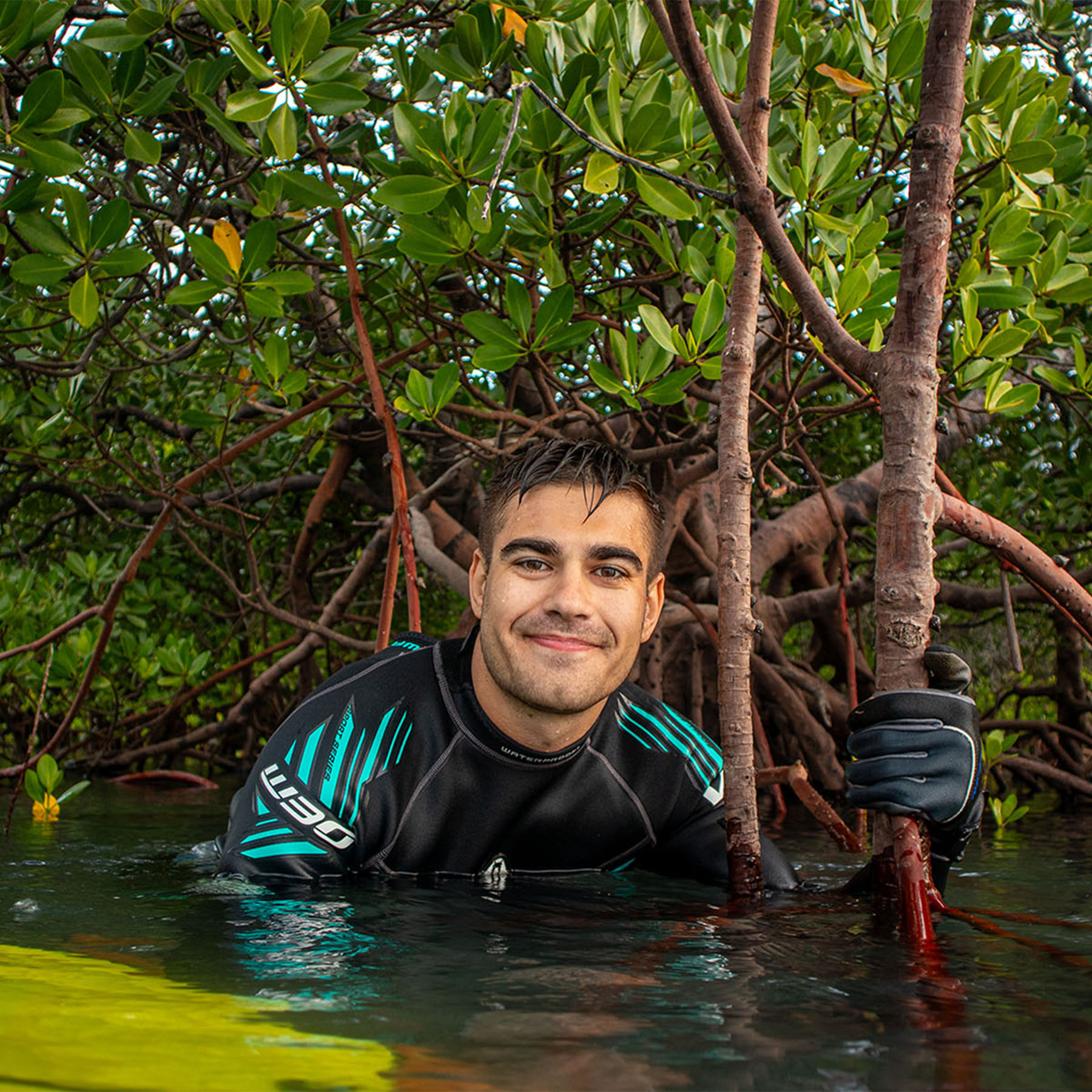
Alexander Waller
Alexander Waller began a PhD in marine biology at the University of Sydney in 2026, after successfully completing a Masters by Research at the University in 2025
“I did my undergraduate degree in the US, but I’d always had a childhood dream of visiting the Great Barrier Reef, especially after hearing how vulnerable it has become. It might not always be there. During my bachelors I did summer courses in Turks and Caicos and in Mexico, which inspired me to study marine biology, and specifically coral reefs.
“Then I thought, why not do a postgrad qualification in Australia and really get to experience it.
“I didn’t have any fixed ideas about which university to go to, so for my MRes I just cast a wide net and tried applying to different universities that seemed to have interesting programmes. It was harder than I thought to get the professors to consider me for a research, rather than a coursework, masters though. I’d done a thesis during my undergrad degree, but we didn’t have a full research course as such, where you go and collect your own data and write your own report on it. I lacked research experience, in their eyes.
“So I spent the summer after graduating doing a research project at a local agricultural center. While it wasn’t marine related, it was a really good experience in terms of understanding exactly what a research project entails – coming up with the research question, setting up the experiment itself, running the experiment, collecting the data, and writing up a paper from it. I got my first publication from that.
“That experience confirmed for me that I wanted to do a research masters, rather than another taught programme. But in Australia academics want you to have completed a university research project, and because I hadn’t done that quite a few of them were hesitant about taking me on to become part of their lab. I was a bit of an unknown quantity for them, I guess.
“I was really fortunate that my professor here at Sydney went out on a bit of limb and gave me the opportunity to join the lab here as an MRes student – I’m really grateful that she took that chance on me.
“Our lab is quite small, there are only six of us in it, but everyone was super-friendly from the get-go, which really helped me to make a strong start to my masters. There are lots of other similar labs to us operating at the University, marine biology labs working on different things, which was also good in that it meant I could make friends with people in other labs who have similar interests to me.
“When I started my MRes our lab had several projects in the works, including one just starting up looking at corals growing in sort of marginal and extreme environments near mangroves. So that’s what my masters project was in. I didn’t start with a specific project in mind. My supervisors had a general topic to work on as part of their grant and their research proposals, and then it was up to me to come up with the specific research question I wanted to look at. They were really helpful in getting me started and setting out what the expectations were for the report, for my thesis and project, and how that aligned with their topics and funding.
“It was a bit intimidating at first, not knowing exactly where the project was going to go. But my supervisors and my lab mates were there to help me along that journey. The university also provides optional courses that you can take if you feel you’re lacking in a particular area that you need for your research. So I was able to take some stats courses, which really helped, as well as other courses related to fieldwork planning and how to actually set up a research project.
“You need to work out how often you sample, where you’re sampling, to build a stronger research question, rather than just going out on a limb and then realising that you should have done something in the first place. I was also very lucky to have my supervisors help out with the planning for my first field trip and actually helping me collect data during it. That set me up well for future field trips in terms of being able to organise everything, and being able to take more experienced researchers from my lab on that trip showed me the best approaches and the level of expectations in terms of what can be achieved in a short time.
“The idea of progressing to a PhD developed during my second year on the MRes. With all the field experience I was getting and the fact that I was really enjoying it, I just decided that I wanted to keep doing it. I found the whole project – coming up with a research question, going out, collecting the data, and then reviewing the data, analysing it, writing a report, very satisfying. So I decided I wanted to do it for another three and a half years!
“I wanted to stay at Sydney because I already had a really good support system here and really enjoyed working here for the two years for my masters. I have the same supervisors for my PhD as I had for my MRes; I am in the same lab. My PhD project is a continuation and expansion of my masters project. That was a narrower project looking at spatial gradients and how corals change from mangrove forests to reefs. For my PhD, I’m expanding that to also look at the effects of cumulative climatic disturbances and not just corals growing near mangroves, but also other reef systems. So seeing how corals can respond and adapt, and how that shapes the briefs for the future.
“I’m not sure what my next step will be after the PhD. After doing all these field trips and projects, I feel inspired to potentially go and work at a field station, which would allow me to be out there on the reef all the time and get to experience all the different research that goes on and be able to help with that. Or continuing with the research with a post doc or as a sort of research assistant job within a lab. I definitely love the fieldwork and research aspect of it and would want to find a job that allows me to keep doing that.
Alex’s top tips for research applications
1. Don’t be afraid to reach out and cast a wide net. At first I just emailed a couple of professors and was only looking specifically at their recent projects, rather than seeing what’s actually available, what’s out there. Be open-minded!
2. Don’t be shy of highlighting your skills and qualifications. At first I wasn’t really selling myself to my full potential. I would mention I was doing this research project, but I could have done a better job of spelling out that it was a full research project that I was running and that it was very relevant to my credentials as an applicant. Don’t downplay things! It’s all well and good attaching your CV to an email, but most academics are busy people, they don’t have time to sit there and read all the fine print. Make it easy for them; spell things out!
3. Know what you want to do. It doesn’t have to be really specific, but knowing what aspect of the field or what topic you want to look at and really showing how interested you are in it is helpful. Academics want people who are passionate about what they do. They want someone who is genuinely interested in the project. Because a research qualification is a lot of work and you’re going to spend a lot of time researching, reading papers, collecting data, analysing the data, so you really have to love what you do!
