
Student Stories
Isabella Ricketts
Isabella Ricketts is studying the Master of Conservation Biology at the University of Queensland. She started her programme in June 2025
“I’ve had family in Australia my whole life so while I’d only visited once, I knew it would be a safe landing spot for me. I was really drawn to studying here because I wanted to pursue conservation. The ecology in Australia is so different and there’s a lot more going on in the field as a whole – there’s a lot more to do.
“The idea really solidified when I went to a postgraduate fair for international
studies and UQ, under Study Options, was there. It was really good to hear how easy it would be to apply and just felt like the right path.
“I did my undergraduate degree in Biology at the University of Bristol. I’d always had an interest in conservation in the way many do – watching David Attenborough when you’re little and so on – but it was really solidified by my undergrad degree, especially during my final year. I got to take a conservation module, which I loved, and then had two tutors for my final projects who both worked in conservation-centred fields. The questions I was drawn to while working with them left me wanting more – that’s when I started to look for postgraduate courses that would allow me to pursue conservation.
“I looked at a lot of places initially; not just in Australia, but that was always in the back of my mind. Queensland was my most obvious option because I’d have family here, and because Brisbane, while still a big city, offers so much for an outdoor lifestyle. I can easily walk to the river and see birds, fish, lizards, and the sun – and the UQ course offered a lot of field trips, which let me see much more of what the region has to offer.
“When I started my study, the first couple of courses were on general conservation, plus some work on policy and how conservation fits into other fields (because when you want conservation to work in real life, you have to integrate it into things like business and commerce and so on). But there were also a lot of ecology focused courses, which are the ones I prefer. We had some stuff on rainforests and on fire ecology – delving into Australian systems. A marine module too. I’ve also learned to use platforms like GIS, a mapping tool every conservationist uses. There has been a real focus on the professional tools, platforms and applications available, geared toward the conservation field. So lots of technical learning.
“Compared to my undergrad degree, here there’s a lot more contact with people who actually do the work that we’re learning about. Even if theirs is not your dream job, it’s obviously important to know how every step of a conservation action or intervention would work. So there’s a lot of integration with every step of the process, which I think is really cool.
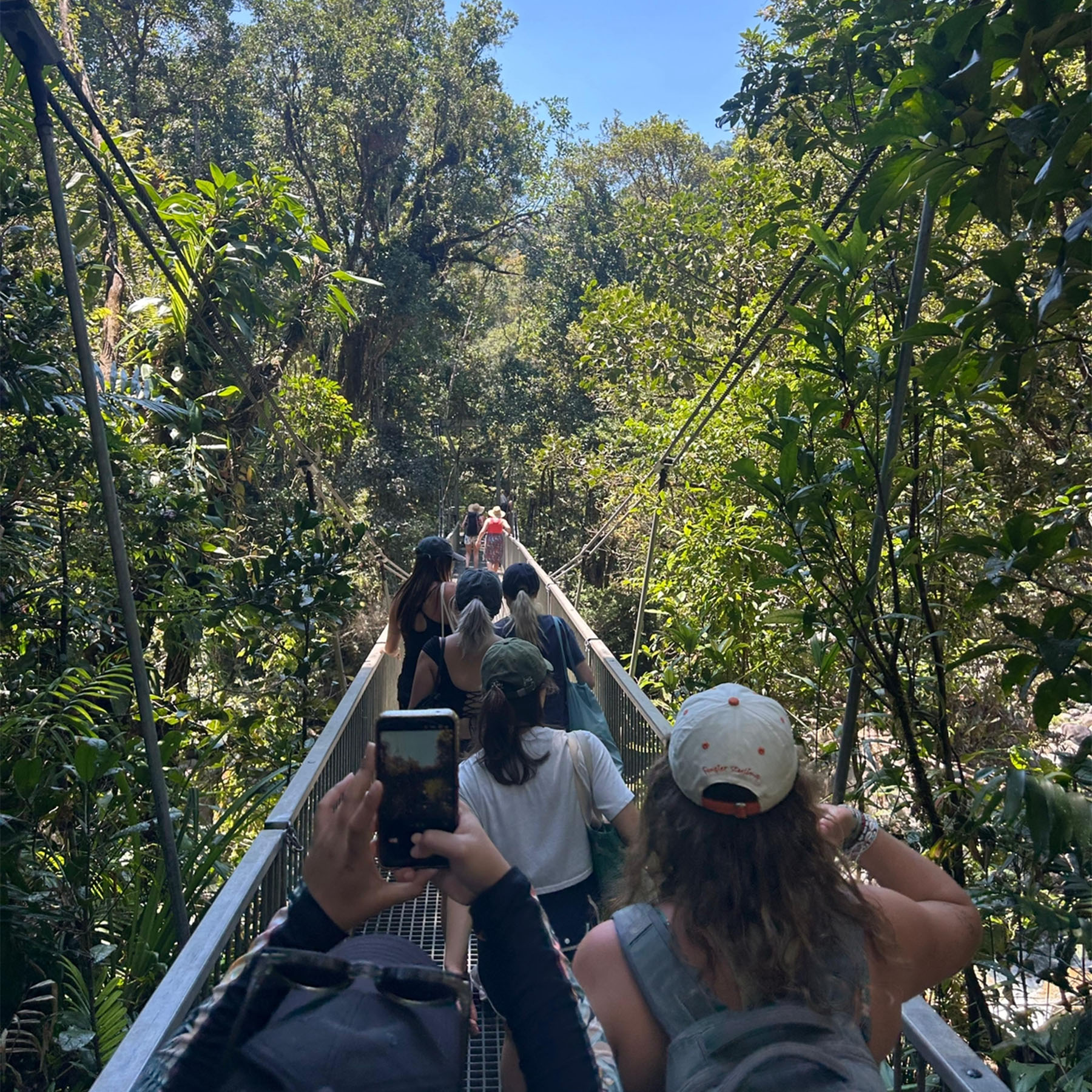
“The course includes a lot of field work. My favourite so far was Lamington Park, which is a big rainforest national park. You get to camp at an overnight stay, and you get to do a lot of sampling in places off path – I would never have been brave enough to just wander into the forest otherwise!
“The other trip people really love is for marine conservation, where you get to stay on a research station in the Great Barrier Reef. You can snorkel every day and take samples across the reef or island to develop your ideas, so it’s really self-driven.
“The UQ Master of Conservation Biology is not a huge course, there’s around 35 people in my cohort. In the first semester, everyone studies the same stuff, but in the second there’s a bit more wiggle room in the modules you choose. And now, in my final semester, I’ve decided to do a research project, which is very free range. So you all start off on the same foundations, but then there is flexibility to tailor the course to your individual interests.
“The University provides opportunities to network. There’ll be PhD students who need volunteers to help them collect data and so on, & occasional events where researchers come together, open to invite students who can chat and watch presentations. There are weekly presentations by researchers within the Uni, or associated with the Uni. UQ does provide opportunities to reach out to people who are already working, and to learn from them.
“Before I started the course I think I was hoping – because of the stereotypes of Australia – that it would be pretty laid back. But of course the workload, while manageable, is higher than it was during undergrad! But in the time off that you do get, there’s a lot more for me to do than there would be back in the UK. I like being outdoors so instead of taking a break and, say, going to the cinema, here I can go to the local reservoir and have a swim, or go to the beach over the weekend.
“A lot of the people that I know share that interest in being outside and getting involved with the lifestyle that Brisbane offers. They’ve come to UQ for similar reasons to mine. It’s nice to be studying with people who have a similar mindset.
Favourite thing about studying in Australia?
“I think the flexibility – that you get to choose what you study in your area of interest – and also how you engage with the teachers. Everybody’s very willing to hear what you have to say and then to take that on and try and adapt it to some kind of research, or a recommendation for your future. I think that commitment a lot of the professors have towards the students and their willingness to be involved is really nice.”
